





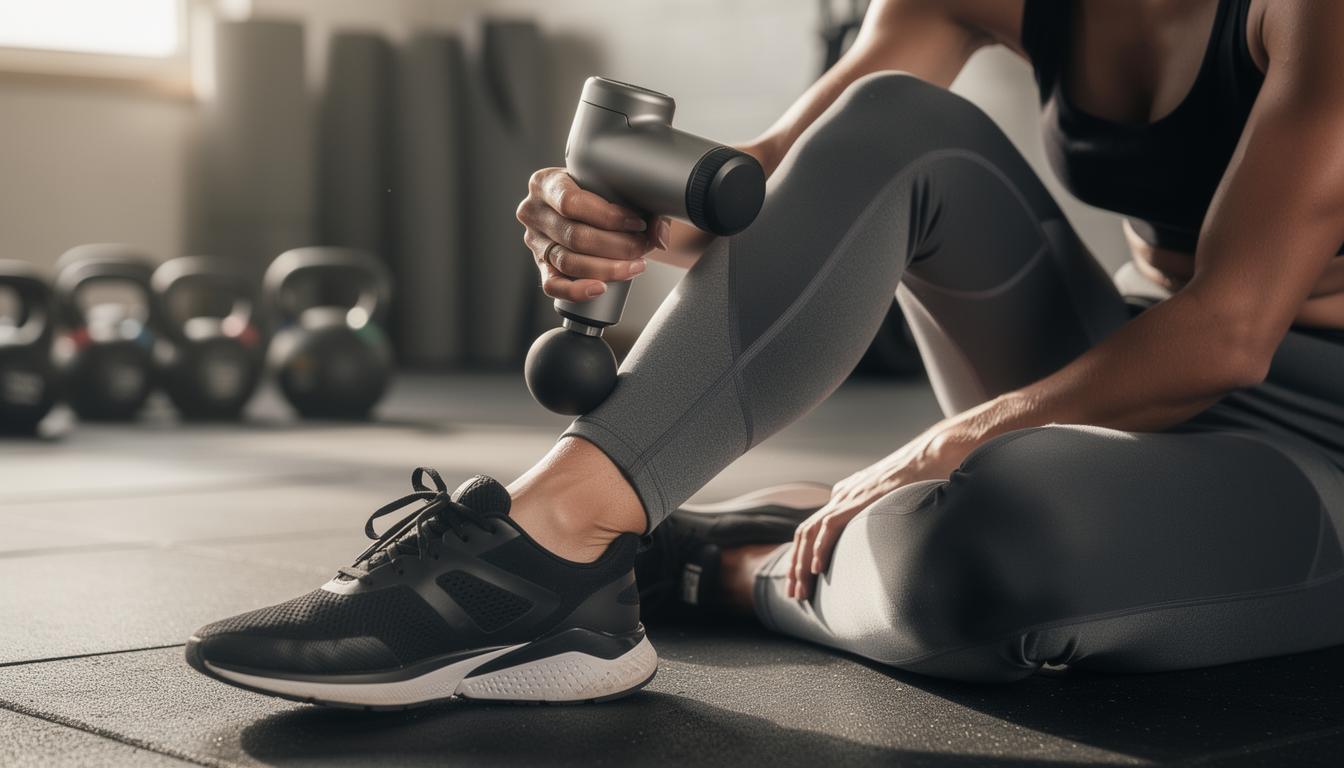
Morning aches bark out their presence, uninvited, beneath the covers, no need to roll over to know the legs set a slow beat. Soreness drags at every step; muscles protest old routines. Enter technology—ready, relentless, vibrating quietly in a corner of the house, promising sudden comfort without scheduling a single visit to anyone’s office. Why does today’s athlete, casual walker, or weekend lifter all gravitate toward these power tools of recovery? The answer doesn’t wait for long wind-ups; it thumps beneath the skin, visible in numbers, and lived through hands-on results.
Additional reading : Maximizing gymnastics potential: how proprioceptive training enhances athletic excellence
The science behind workout recovery with massage guns
No need to play guessing games with opinions—talk real studies and measurements. What makes these percussive tools such a shock to the system, in the best possible way? The repetitive impact isn’t just noise, it acts. The American Journal of Sports Medicine confirmed in 2026—a session with a recovery gun boosts blood flow and increases temperature within minutes. Soreness from lactic acid doesn’t get to settle; everything circulates. Why stall with aching micro-tears when the solution sits in your palm? For broader insights and resources, discover more at Massage-gun.
Also to see : Achieve pain-free running: essential exercises to avoid iliotibial band syndrome
Scientific consensus forms swiftly, a cluster of NCAA trainers in 2026 signals the effect: post-workout massage guns used by athletes reduce next-day pain far more efficiently than foam rolling or stretches ever achieved. The tool speaks to biology, not only to belief. Last sets finish strong, muscle knots calm under pulsing heads, recovery steps onto new ground.
The difference with traditional recovery methods
Old allies—foam rollers, static stretching, hands kneading thighs—stand the test of habit, but time, convenience, and precision escape them. Foam rolling: slow, clumsy, and the knot remains elusive. Traditional massages: never portable, always booked. Static stretches run risks of their own, all while relief hides somewhere else. Welcome the rapid, pinpoint nature of percussive recovery. Everything gets done while the kettle hums or the emails stream in.
Numbers reinforce the change. FITNESS Tech Review 2026 describes users slicing recovery times by a third when wielding these modern guns instead of enduring old-school stretch routines. Suddenly, every ache becomes a choice, not a fate. A brief comparison, based on real feedback and not just sales hype:
| Method | Intensity Control | User Accessibility | Recovery Speed |
|---|---|---|---|
| Percussive massage devices | Adjustable with various settings | High with solo use and portability | Fast, up to 35 percent quicker |
| Foam rolling | Manual and shallow depth | Medium and awkward reach | Moderate pace |
| Professional massage | Needs a trained specialist | Low access with required appointments | Slow or sometimes moderate |
| Static stretching | Minimal direct control | Very high without tools | Slow adaptation |
Average user feedback; source FITNESS Tech Review 2026
The adaptation of massage guns for workout recovery in athletic routines
Performance climbs steeply when recovery keeps pace, not a new lesson, just one seen in real time. Sprinters, lifters, even ordinary gym goers repeat the same observation: less time limping, more time thriving. The numbers speak sharply—University of California Human Performance Lab, 2026, tested athletes on both sides of the spectrum. Swelling shrinks, tightness fades, post-gym stiffness drops. Gone, the trap of waiting days to regain comfortable movement. It surprises, then it becomes the new standard.
The promise of improved recovery and flexibility
After every demanding squat or sprint, post-exertion sabotage usually lurks. Instead, relief comes quickly, not just in wishful thinking, but measured in firm statistics. Studies compare repeated percussive use to traditional ice: swelling and localized pain fall dramatically, flexibility keeps expanding long past the initial burst. Stories travel by word of mouth through gyms and clinics, not rarely but everywhere. Forward momentum isn’t lost: strong legs, supple joints, no more excuses.
Athletes won’t look back. Flexibility improves; range of motion grows. Strong endorsement isn’t manufactured—it comes from the undeniable experience of waking two days after a hard session, ready, rather than resigned.
The home recovery revolution
No reason remains to lug yourself into a clinic, or contort painfully over a foam roll. These recovery tools now fit in a gym bag, a desk drawer, even the back seat. Users don’t need training, just a bit of experimenting, and suddenly, muscles surrender to targeted pressure. Flexibility wins—you lie on the couch, choose a speed, swap an attachment, and off you go. The simplicity surprises the skeptics and spoils the patient.
The 2026 Consumer Health Tech Survey highlights a striking fact: more than 70 percent value at-home freedom as their reason for investing in percussive recovery. Adaptability rules—whether tending a stubborn calf muscle during movie night or a quad after a double shift, the control stays in your hands.
The factors to review before selecting a massage gun for muscle recovery
Choices doesn’t mean confusion if the direct criteria matter most. Ignore packaging, set aside the slogans, and look straight at the mechanics. Power falls in amplitude: a device that pushes deeper solves knots better. Multiple speed settings adapt to every muscle group and pain threshold. Battery duration—unseen but felt—prevents abrupt interruptions mid-session. Sound matters more than expected: a low hum blends into routine; a loud buzz disrupts peace in every shared home.
The characteristics that determine effectiveness for workout recovery
Some details don’t only transform performance—they decide if a tool survives more than a month. Long handles reach the stubborn spots on the back, lightweight builds give anyone’s arms a break. Brands with consistent five-star records don’t simply rest on reputation—they earn it in repeated, frustration-free use. User responses cited in TechNavio’s 2026 summary make it clear: easy battery changes and adaptable heads matter more to user satisfaction than any advertised discount. The surprises unfold not in showrooms, but in real bedrooms and backyards.
- Adjustable amplitude fixes deep tissue tension
- Long battery means every muscle gets attention in one session
- Multiple attachments adapt for every muscle group
- Quiet motors reduce disruption at home or at work
The review of leading brands and usable models
No need to wade through endless online reviews: a handful of names dominate the discussion. Theragun Pro: six heads and a near-silent engine, offering hours of tailored relief. Hypervolt Plus, light and untethered, manages up to three hours without breaking stride. Ekrin B37 delivers in force, skips frills on price. In user forums, lively arguments circle the holy trifecta—silence, endurance, and versatility—while warranty terms trigger stories of regret or triumph. Real-world performance beats listed stats; personal stories, not product spreadsheets, raise the true winner for every aching limb.
The strategies for using massage guns after exercise for recovery
No universal script fits everyone; routine builds from pain points and past mistakes. Best results come when guns glide across skin during post-workout circulation surges; that moment delivers maximum muscle elasticity, minimum bruising. One to two minutes, per muscle, at most—prolonged focus never speeds healing, it turns redness into regret instead. The trick: adapt the routine to the body’s signal; some days tightness whispers, other times it shouts, but blind repetition wins nothing.
The ideal moments and target areas for the best effect
Precise timing matters. Muscles need quick intervention; finish the training, start recovery. Attention falls on legs, glutes, calves—wherever stress lingers, wherever fatigue jeopardizes another session. Respect personal warning signs; discipline, not relentless force, keeps floors safe and progress steady. Those who practice, consistently and thoughtfully, hold the edge the next day.
Consistency outshines intensity every single time; pain perfectly measured leaves you ready, never vulnerable.
The advice and precautions for safe recovery with massage guns
Habits grow, some helpful, some hazardous. Signs of chronic pain—unexpected, familiar, or somewhere between—demand one consultation before the tool hums again. Never mash the unit against bone or joints; keep to muscle, avoid tempting bravado. Begin with the lowest speed, judge the effect, inch upward only after comfort settles in. Manuals go unread at home, but warnings matter; safety repeats quietly in professional circles. Pain masks nothing; it signals; it warns; it demands respect, not defiance. Healthy tissue always wins when treated with prudent care.
One story circulates through every gym: Rachel, flight imminent, lifts her battered Hypervolt after a brutal CrossFit night. Tension crackles under her skin—the gun wakes up, vibration crawls. The ache vanishes; coach nods in approval. The next day, muscle soreness barely whispers. A tool becomes a phenomenon; teammates borrow, results ripple through the room. Recovery lost its exclusivity that afternoon.
The emergence of massage guns in modern fitness trends
Locker rooms now buzz with the sound of recovery, not chatter. Teams select recovery tools as routinely as uniforms, the motion second nature. Physical therapists prescribe these devices, Mayo Clinic surgeons suggest them post-surgery when appropriate. The shift is no longer exclusive—private clinics rent out units, technology democratizes muscle care. Smart features worsen the addiction: sensors, mobile connectivity, adaptive feedback reshape ordinary routines. No fluff, just progress tracked and measured by the latest standards, as the National Athletic Trainers’ Association rolls out protocols for all.
The interplay of recovery tech and digital apps for massage guns
Simple switches no longer satisfy today’s recovery seeker. Now, digital apps sync sessions, monitor heart variance, tailor every pulse to recent workouts. Integration meets expectation—Apple Health, Garmin, Oura, and Fitbit all piece together the fatigue puzzle. The ordinary recovery gun evolves: it remembers last week’s intervals, foresees tomorrow’s needs, and syncs quietly in the background. Suddenly, recovery grows personal, adaptive, intelligent—adjusting with every step, every lifted weight, every lingering ache time rushes past.
Discussion never quite ends. Seen friends glide through soreness, rebounding with suspicious haste? Recovery shifts in real time, sometimes behind closed doors, sometimes at airports. The rhythm won’t slow, the vibration won’t cease its call. Open a drawer, grip the handle, and muscle care in 2026 transforms once again, piece by calculated piece.